
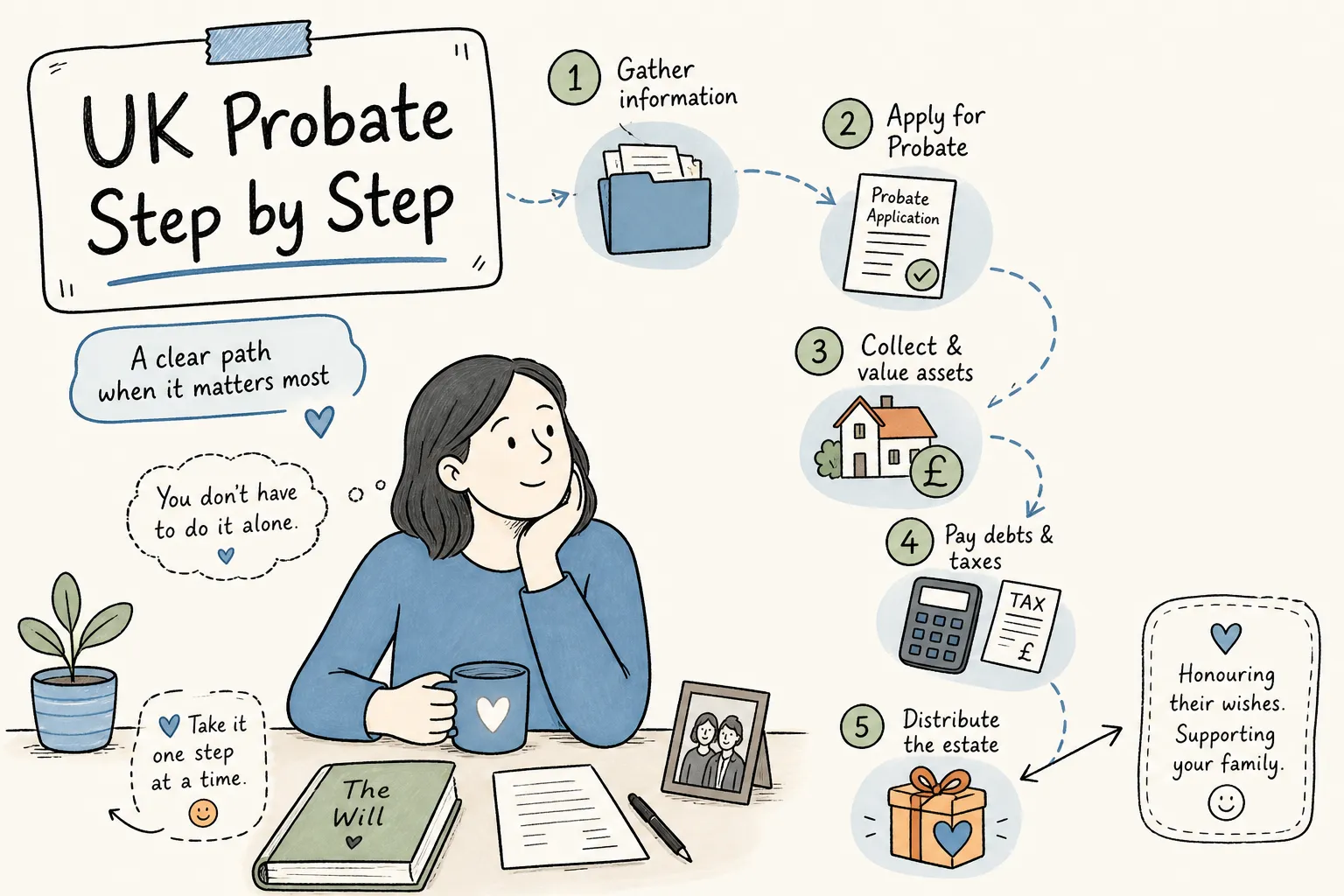
UK Probate process: a step-by-step guide for executors
Being named as an executor is an honour. It is also, for most people, a sudden introduction to a legal process they have never encountered before. Someone you cared about has died, grief is fresh, and yet here you are, responsible for gathering assets, settling debts, and distributing an estate correctly. The UK probate process sounds more daunting than it often is, but certain estates genuinely do require careful handling, and the consequences of getting it wrong fall on you personally.
At Nicholls Law, our probate team in Rochford, Essex, regularly guides executors through the probate process in England and Wales. The questions are almost always the same: do I actually need a grant? What forms do I complete? How long will this take? What does it cost? This guide answers all of those questions in plain language, so you can approach the process with confidence rather than anxiety.
Do you actually need a grant of probate?
The first decision an executor faces is whether a Grant of Probate is required at all. There is no single universal threshold in England and Wales that automatically triggers or avoids probate. What matters is whether each individual asset holder requires formal legal authority before releasing funds or transferring assets.
Assets that nearly always require a grant
Property held solely in the deceased’s name almost always requires a Grant of Probate, regardless of its value. The same applies to shares and investments registered in the deceased’s name alone, and to bank or savings accounts above a provider’s own release limit. That limit varies considerably from one institution to another: some providers release funds up to £5,000 without a grant; others set limits as high as £50,000. The institution’s own policy is what counts, not any universal figure.
When an estate can bypass probate
Assets passing by survivorship do not require a grant. A jointly held bank account or a property owned as joint tenants passes automatically to the surviving co-owner outside of probate. Similarly, if every account in the estate falls below each institution’s individual release threshold, those funds can sometimes be released on production of a death certificate and will alone. Do not assume this applies without checking: a sole account of £40,000 at a bank with a £25,000 limit will require a grant, even if the rest of the estate is modest.
The practical rule before applying
List every asset the deceased held and contact each provider directly. Ask four questions: Does this asset require a grant? What is the current release threshold? Is that threshold per account, per institution, or based on the entire estate? Is there a small-estate procedure? Doing this systematically at the outset saves significant time and prevents false starts later in the process.
Step-by-step: how the UK probate process works
Where a grant is required and the deceased left a valid will, you will apply for a Grant of Probate using form PA1P. The online application route is simpler for most estates, but the underlying process is the same either way.
Gathering documents and valuing the estate
Start by registering the death and obtaining the official death certificate. Locate the original will and every codicil; a photocopy is not sufficient unless the Probate Service specifically permits it. Decide which executors will apply jointly. Any executor who does not wish to act can formally renounce, provided they have not yet taken any steps to manage the estate.
Then systematically value every asset and liability at the date of death. This typically includes:
- Property and land
- Bank and savings accounts
- Investments and shares
- Pensions and life policies
- Vehicles and personal possessions
- Digital assets
- Outstanding debts, mortgages, and funeral costs
Inheritance tax and the HMRC step
The inheritance tax position must be resolved before you can apply for probate. Excepted estates report basic values within the application form itself. Where a full return is needed, form IHT400 must be submitted to HMRC and at least 20 working days must pass before you can apply. If tax is payable, the Direct Payment Scheme allows participating banks and providers to transfer funds directly to HMRC from the deceased’s accounts before the grant is issued. This avoids the frustrating chicken-and-egg problem of needing a grant to access funds that are needed to pay the tax. HMRC then issues a reference number that feeds into your probate application.
Completing form PA1P and submitting the application
The online application asks for the deceased’s details, information about the will and executors, gross and net estate values, and the inheritance tax position. After submitting online, you send the original will and codicils, along with any other evidence requested, to the Probate Service. Keep copies of everything and retain proof of posting.
The current application fee, as of July 2026, is £526 for estates valued above £5,000; there is no fee for estates at or below that threshold. Additional sealed copies of the grant cost £2 each when ordered at the same time as your application, rising to £16 per copy if ordered afterwards. Each major asset holder, for example, each bank, share registrar, insurer, or Land Registry, will typically require its own sealed copy, so it is worth ordering enough at the outset and checking with each provider what they need.
After the grant arrives: collecting assets and closing the estate
The grant confirms your legal authority to act on behalf of the estate. Use sealed copies to instruct banks, investment providers, share registrars, and other asset holders to release funds. Collect all assets, settle outstanding debts, discharge any remaining tax, and prepare estate accounts. Distribute the balance in accordance with the will only once debts, tax, and any potential claims against the estate have been fully resolved. Distributing early exposes you to personal liability.
What if there’s no will? The intestacy route explained
How intestacy rules decide who inherits
When someone dies without a valid will in England and Wales, the intestacy rules dictate who inherits the estate. The order of priority starts with a surviving spouse or civil partner, then children, then wider family in a prescribed sequence. One consequence that regularly catches families off guard: a cohabiting partner has no automatic entitlement under intestacy, regardless of how long the couple lived together or how financially interdependent they were. The deceased’s wishes, however clearly expressed in conversations or informal notes, cannot be given effect without a valid will. That is why we always recommend getting a will in place, no matter how straightforward your circumstances seem.
Applying for letters of administration (PA1A)
Without a will, the person administering the estate applies for Letters of Administration rather than a Grant of Probate, using form PA1A and becoming the administrator rather than an executor. The process is broadly the same: value the estate, determine the inheritance tax position, complete the application, and pay the fee. The key difference is the additional evidence required to establish the applicant’s entitlement under the intestacy rules, including birth certificates, marriage or civil partnership certificates, and any other documents proving the family relationship. Where others have equal or prior entitlement but are not applying, signed renunciations may also be needed.
How long does the probate process take in the UK?
Obtaining the grant and closing the estate are two very different things, and conflating them leads to unrealistic expectations. For a straightforward online application, the grant itself may arrive in roughly four to six weeks, based on typical HMCTS processing times. The grant is not the finish line, it is permission to start collecting and distributing assets, a process that takes considerably longer.
Realistic timelines for different estate types
Simple estates with a clear will, no property sale, no inheritance tax, and cooperative beneficiaries typically reach full distribution in three to six months. Average estates involving one property, ordinary investments, and modest tax matters generally take six to twelve months. Complex estates with multiple properties, overseas assets, business interests, or disputes can run to twelve to eighteen months or well beyond. Plan for the middle range unless you have good reason to expect otherwise.
The most common causes of delay
Several factors can slow down the UK probate process considerably. It helps to know them in advance:
- HMRC processing: at least 20 working days must pass after submitting IHT400, and any HMRC queries add further time.
- Incomplete paperwork: errors or omissions cause the Probate Registry to pause the application while corrections are sought.
- Property issues: valuations, sales, and title complications add months to most estates that include real estate.
- Missing beneficiaries or assets: tracing individuals or overlooked accounts takes time.
- Overseas assets: these may require a separate foreign probate process.
- Business interests: specialist valuations are often needed and can take time to commission.
- Disputes: a challenge to the will’s validity, or a claim under the Inheritance (Provision for Family and Dependants) Act 1975, can halt distribution for many months.
- Paper applications: consistently and significantly slower than online submissions.
Probate costs: court fees, inheritance tax and solicitor charges
Court fees and what the grant actually costs
The probate application fee is £526 for estates valued above £5,000, as of July 2026. Estates at or below £5,000 pay nothing. Sealed copies cost £2 each when ordered with the application, rising to £16 per copy if ordered later. Ordering enough copies upfront, one per major asset holder such as each bank, insurer, or share registrar, is far more cost-effective than returning for additional copies later.
Inheritance tax: thresholds, rates and a worked example
The standard nil-rate band sits at £325,000 per person, currently frozen through 2030 to 2031. Where a qualifying home passes to direct descendants, the residence nil-rate band adds up to £175,000, giving a potential combined allowance of £500,000. Unused allowances can transfer to a surviving spouse or civil partner, potentially providing up to £1 million in combined relief. The standard inheritance tax rate is 40% on the taxable amount above available allowances, reduced to 36% where at least 10% of the estate passes to charity.
As an illustration: a £600,000 estate qualifying for the full nil-rate band and residence nil-rate band leaves £100,000 taxable, producing an inheritance tax charge of £40,000 before any additional reliefs are applied. Taper relief and other exemptions may reduce this further depending on the specific circumstances, HMRC’s published guidance sets out the full eligibility criteria.
Solicitor fees: what’s typical and how charging works
For a grant-only service, where the solicitor obtains the grant and the executor handles the rest, fees commonly fall in the range of £500 to £1,500 plus VAT. Full administration of a straightforward estate commonly costs £1,500 to £5,000 plus VAT, rising significantly for complex matters involving inheritance tax returns, multiple properties, or business assets. These are commonly reported ranges drawn from Law Society guidance and market surveys; individual firms will vary. Percentage charging, where firms bill one to four percent of the gross estate, can produce a high bill for a straightforward but valuable estate.
Always request a written quote specifying whether the fee is fixed, hourly, or percentage-based; whether VAT is included; and which disbursements are charged separately. For a £500,000 estate at a 2% fee, that is £10,000 before VAT, so the comparison between charging models matters enormously.
When to instruct a probate solicitor
Straightforward estates, those with no property, no inheritance tax liability, cooperative beneficiaries, and a simple asset mix, can often be handled by an executor without professional support. Others genuinely cannot, and attempting them without expert help creates real risk. Seek legal advice before proceeding if any of the following apply:
- The estate includes solely owned property or a share held as tenant in common
- IHT400 must be filed
- The original will is missing, disputed, or contains alterations
- There are overseas assets
- The estate is insolvent
- A beneficiary is a minor or lacks mental capacity
- There is a potential family provision claim
- There is disagreement among executors or beneficiaries
Any one of these factors significantly increases the risk of errors that delay distribution or expose executors to personal liability.
At Nicholls Law, we offer tailored probate administration from our office in Rochford Market Square, covering everything from grant-only applications to full estate administration and inheritance tax planning. Our pricing is transparent and published, so you know what to expect before you commit to anything. Many executors tell us that professional support was worth it for the time saved and the peace of mind alone, particularly when the estate turned out to be more involved than it first appeared.
If you’re not sure whether your situation calls for professional help, reach out to our team for an initial conversation. There’s no pressure and no obligation, just a straightforward discussion about the estate’s circumstances and what makes sense for you.
Your next steps as executor
You’re reading this because someone you cared about has died and you have a responsibility to fulfil. The core decision tree is simpler than it first appears: check whether a grant is required, gather the correct documents, determine the inheritance tax position, apply via PA1P or PA1A, and plan for a six to twelve month timeline on a typical estate. The probate process in the UK is manageable for many straightforward estates, particularly with clear records and cooperative beneficiaries.
When complexity appears, professional guidance stops being a luxury and becomes a practical necessity. Errors in estate administration can expose executors to personal liability, delay distributions, and cause lasting damage to family relationships at an already difficult time. Taking advice early is almost always cheaper than correcting mistakes later.
Nicholls Law is here for executors who want expert support without the impersonal experience of a large national firm. We take time to understand your estate and your circumstances, explain costs and timelines clearly from the outset, and guide you through every stage of the UK probate process with care and clarity. Get in touch whenever you’re ready, we’re here.