

This or That: Solicitors Edition
The ‘This or That’ trend seems to be taking off on social media. We thought we’d jump on the bandwagon and give some insight into the decisions that solicitors and other legal professionals will make daily, which often help them avoid trouble later down the line.
Litigation work is our firm’s ‘bread and butter’. Sadly, much of litigation work tends to be reactive instead of proactive. However, working on the opposite side of things has given us key insights into how to avoid problems before they arise. We have written this blog in the hope we can impart some wisdom to help you proactively avoid problems.
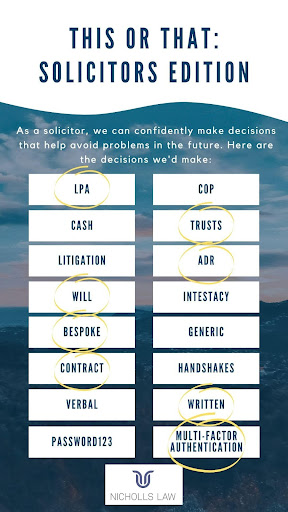
LPA or COP
An LPA is a Lasting Power of Attorney and a COP is a Court of Protection order (Deputyship Order). In practice, these aren’t that different. What does make them different though is speed and efficiency. An LPA is something that you put in place before you lose capacity and allows others to legally make decisions on your behalf. The transition here is smooth and means you are always protected. Not having one in place, means that when you lose capacity (temporarily or permanently) you, your family, and your loved ones lose the ability to make decisions on your behalf. The decisions then fall into the hands of the local council and courts. You can apply for a Deputyship Order to allow your loved ones to make these decisions for you, however, there is approximately a 9-month delay between making an application and the courts granting an order. This means 9-months with strangers making your health and care decisions, including medical and care home placement decisions. And nobody able to progress financial decisions such as accessing your bank account, or selling your property to fund care home fees.
Therefore, the wise choice is to get an LPA in place early, well before the time you will need it, to ensure you are protected later in life.
Cash or Trusts
Money, and other assets, are susceptible to a myriad of threats and risks. Trusts can be an excellent way to mitigate that risk. For example, you may wish to bequeath an asset to a young member of your family but are worried that they may “blow” their inheritance but you want to give them it as an investment. Putting this asset in a trust would enable you to have some control over how that asset is used. Trusts can also help protect assets from claims made by partners in divorce proceedings or financial institutions in bankruptcy proceedings.
Trusts are very powerful and can help in a variety of ways, however, they are very complex, and therefore expert, personalised advice is needed. There has to be a legitimate reason for setting up a trust. A trust set up with the main purpose being to hide assets from creditors, spouses and to avoid paying care home fees for example are liable to be set aside under the law. Help is at hand. We can help guide you through the maze in this complex area. Message us today to arrange a call back from one of our Elder Client Estate and Asset Protection team members.
Litigation or ADR
Alternative Dispute Resolution (ADR) is usually the better option than litigation as it can save time and money. Litigation can be very costly and, due to court timetables and official procedures, litigation is very time-consuming. This can result in years of legal battles, expenses and avoidable stress. Furthermore, litigation has far less control over the outcomes than ADR. In ADR all parties are able to decide for themselves how they would like to settle, whereas in litigation the decision is left to the judge on the day which is likely to have an outcome which at least one party won’t like. Moreover, when matters go to trial they are no longer confidential which means anyone can find out about your business.
It’s important to note that ADR does not always work out, as sometimes parties just cannot see eye-to-eye. Therefore, a third party (the judge) needs to make the decision for them. However, it is important to attempt ADR before starting litigation.
We will have a better solution for you!
Will or Intestacy
Throughout the year, you make many decisions for how you spend your money and who you gift it to; whether that’s Christmas presents, Easter Eggs, or supporting charities. You like to choose who you’re giving things to and how much. So, why not do the same when you pass away? As, broadly speaking, this is what you are doing with a Will anyways. Importantly, this gives you control over your wishes after you are gone. Furthermore, the Intestacy Rules are very limited and do not suit modern life, which could lead to some of your loved ones missing out. Importantly, dying without a Will in place costs estates around £9,700 in lost assets only, not including fees, inheritance tax or ‘heir hunters’ and also could make probating the estate far more complicated.
Therefore, the clear choice for a lawyer is to proactively take control and make a Will, instead of leaving it up to someone else to decide where your assets go.
Bespoke or Generic
With the wonders of the modern internet, it takes just seconds to have a variety of generic, DIY legal documents fall on your lap with one simple search. And although a solicitor will always encourage you to have something in place instead of nothing, we’d also always encourage you to have a bespoke document drafted by professionals. Whether that’s a rental agreement, building contracts tenancy, Will, loan document, employment contract, privacy agreement, and so on. It’s important to get a bespoke document that actually reflects your true needs. Importantly, using online templates can impact the legitimacy of your document and could lead you to awkward or costly situations that could have been avoided.
Bespoke advice is always key and will always be what lawyers are drawn to. Importantly, at Nicholls Law, we appreciate that budget can be an impacting factor for why individuals may choose generic or DIY documents over professionally drafted ones. Therefore, we offer the ‘Goldie Locks’ style service with three levels, Papa Bear service where we do everything for you, Mama Bear where we work together, or Baby Bear where you do most of the work but seek our advice on specific queries. Speak to us today to find out more.
Contract or Handshakes
Chivalry is dead – although we like to believe that handshakes are a signifier of trust and mutual understanding as well as an indicator of future behaviour, sadly, that is not always the case. Believe us, we have seen enough cases where something was shaken upon but then lead to later conflict. Having a contract in place is important, as this a formal record of what was agreed, that works both as a reminder and a measurement tool to ensure both parties are acting in an agreed manner.
Handshakes are a great place to start agreements, however, they should always be finished with a formal contract which is what a lawyer will always choose.
Verbal or Written
Building upon the previous point, you always want to ensure you get as much as possible in written communication. This will give you a paper trail of physical evidence, which – if needed – you could use at a later point in court. With verbal evidence, it is much harder to prove what was said and agreed. Furthermore, verbal agreements can easily be clouded with differences in understanding or forgetting certain details, unless they have been appropriately recorded. They also give much more opportunity for someone to change their mind or manipulate parts of the agreement.
Therefore, it is always recommended to get a confirmation in writing for anything agreed upon.
Password123 or Multi-Factor Authentication
Password123 is one of the most common passwords used today. Other popular passwords include; qwerty, password, 123456, picture1, abc123, iloveyou, letmein and princess. For a hacker, it would take them mere milliseconds to crack your password and gain access to your account. This puts you at risk. Aside from creating strong passwords that are unique for all your logins, multi-factor authentication is an excellent method to provide an extra layer of security. As they would not only need to crack your password but also access your authenticator/s, such as phone, app or email. In most cases, it is quick and easy to set up and the upside of the added security far outweighs the inconvenience some may feel this causes.
When deciding passwords and security remember that you are trying to make it difficult for a computer – not humans. Computer security is a priority to lawyers and should be a priority to you too.
We hope you enjoyed this blog and it gives insight into the types of choices that lawyers make and, hopefully, will enable you to avoid problems in the future. If you would like to contact us to talk through any of these points, please do. We look forward to hearing from you.
*Notice: This blog does not constitute legal advice*